Capital Markets Infrastructure · Executive Insights
For LendersThe $805 Billion Opportunity Your Desk Is Missing: And Why It Has Nothing To Do With Capital

Wryland Reed11 Min Read
Your senior analyst just burned 40 hours on a deal that was dead before she opened the PDF.
You knew it. You approved the workflow anyway.
That ends today.
The Market Is Surging. Your Conversion Isn’t.
The Mortgage Bankers Association projects $805 billion in commercial and multifamily originations in 2026, the largest volume in years. Banks are up 80%. Private credit is up 133%. CMBS is at multi-year highs. The refinancing wave everyone predicted is here.
But for most middle-market debt desks targeting the $3M to $25M bracket, that number is mostly theoretical.
More capital options mean more lenders competing for the same borrower. Life insurance companies, CMBS conduits, private credit funds, and regional banks are all fighting for quality deals, and spreads have compressed accordingly. The only remaining competitive advantage in this market is speed to a qualified credit decision, and most desks are structurally incapable of delivering it.
The Dead Deal Tax Is Eating Your Desk Alive
“62% of analyst time is spent on data entry. Not analysis. Not credit judgment. Copying numbers from PDFs into Excel.”
CBRE 2025 CRE Research
CBRE’s 2025 research found that 62% of institutional acquisitions analysts spend most of their time on data entry, not analysis, not credit judgment, not deal selection. Copying numbers from PDFs into Excel.
A deal package with 15 documents consumes 7.5 to 10 analyst hours on extraction alone before a single underwriting judgment is made. With 10 to 15 new offering memorandums arriving each week and roughly 80% dying at initial screening, the Dead Deal Tax costs $15,000 to $25,000 per analyst per year in wasted salary capacity.
Run that number. Two analysts. Forty weeks. That is $30,000 to $50,000 burned annually on deals that were never going to close. The bottleneck was never capital. It was Monday morning data entry. And it is costing you deals you should be closing while your competitors are already on the phone.
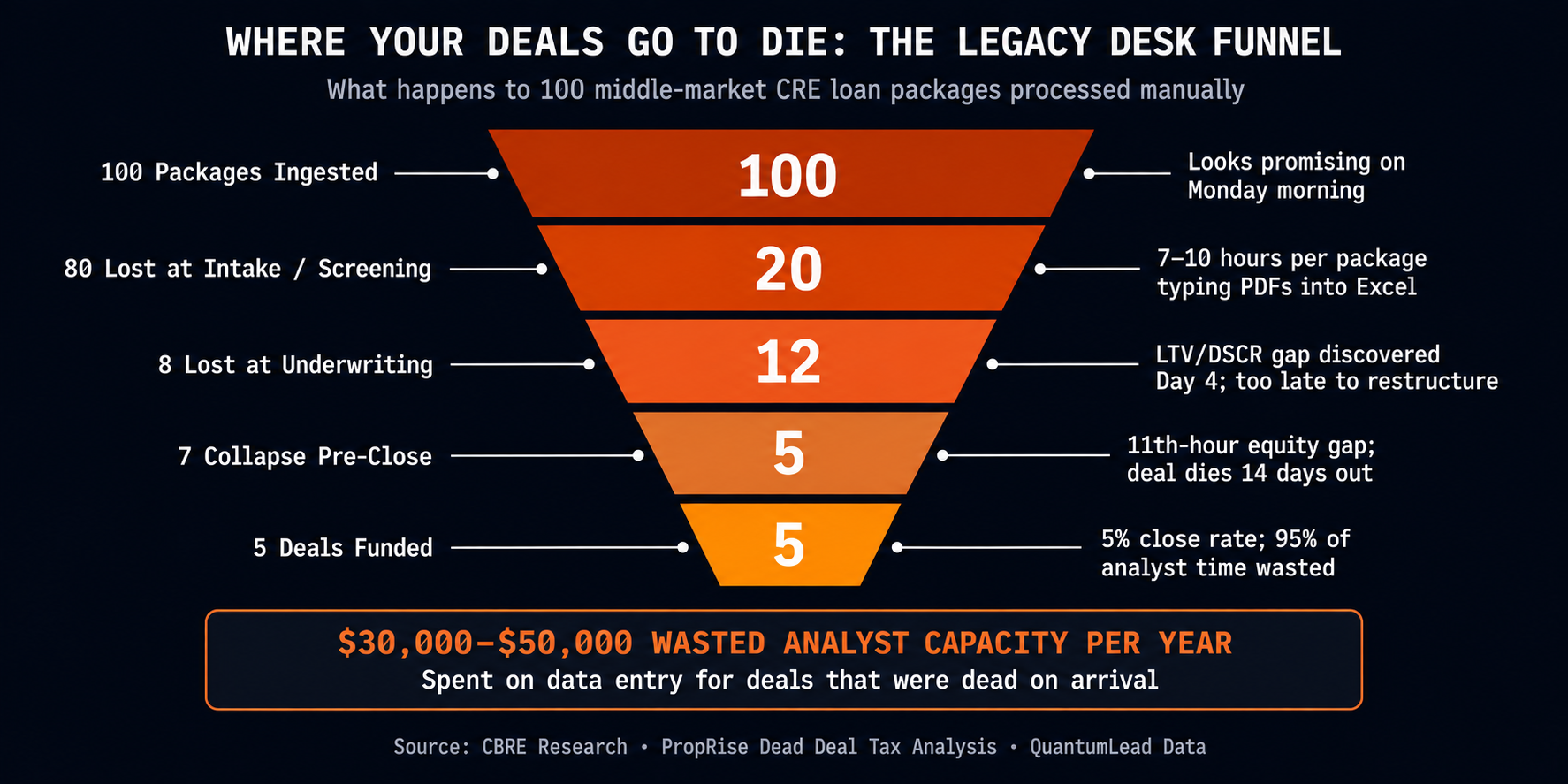
Data Summary: Legacy CRE Underwriting Funnel
- 100 packages enter intake.
- 80 packages lost at manual screening (7-10 hours burned per package typing PDFs).
- 8 packages lost in underwriting due to late LTV/DSCR gap discovery on Day 4.
- 7 packages collapse pre-close due to 11th-hour equity gaps.
- 5 packages funded (5% baseline yield).
- Financial Waste: $30,000 to $50,000 in burned analyst salary capacity per year.
The Eight-Lender Race You Keep Losing
When a middle-market sponsor begins navigating an upcoming loan maturity, they submit an inquiry through a general broker. Within hours, that file is multi-sold to half a dozen regional private credit platforms.
By the time your origination team contacts the borrower, three other lenders already have. You are now in a pricing war you did not choose to enter on a deal you have not even underwritten yet.
“Borrower conversion rates drop dramatically when inbound inquiries are not qualified within minutes. Not hours. Not the next business day. Minutes.”
The borrower who contacted you at 11:47 PM has already decided which lender they like best by 9 AM the next morning. Your careful, methodical process is the reason you are not in that conversation.
The 11th Hour Collapse Nobody Talks About
Even when your team moves fast and gets to underwriting, there is a second failure mode burning deals 14 days before closing.
Cap rate expansion forces a senior LTV cut from 75% down to 65%. Now there is a $1.5 million to $3 million equity gap in the capital stack. The sponsor does not have it. The deal collapses.
Your analyst just burned 30 hours on a transaction that was structurally broken on Day 1. With $3.4 trillion of real estate debt requiring refinancing in the next few years, these collapses are not isolated events. They are the defining operational failure of desks that have not modernized their intake infrastructure.
What The Best Desks Are Doing Differently
According to McKinsey’s research on CRE operations, top-quartile acquisition teams differentiate on deal selection quality from a larger evaluated pipeline, not on working harder or hiring more analysts. CRE investors who adopt automated intake workflows close deals 30% to 40% faster than those using legacy sequential review processes.
The firms winning in 2026 built systems that handle what was eating their analysts’ hours, so their analysts can do what only humans can do: credit judgment, relationship building, and deal structuring. That is the infrastructure shift. And it is what we built QuantumLead to deliver.
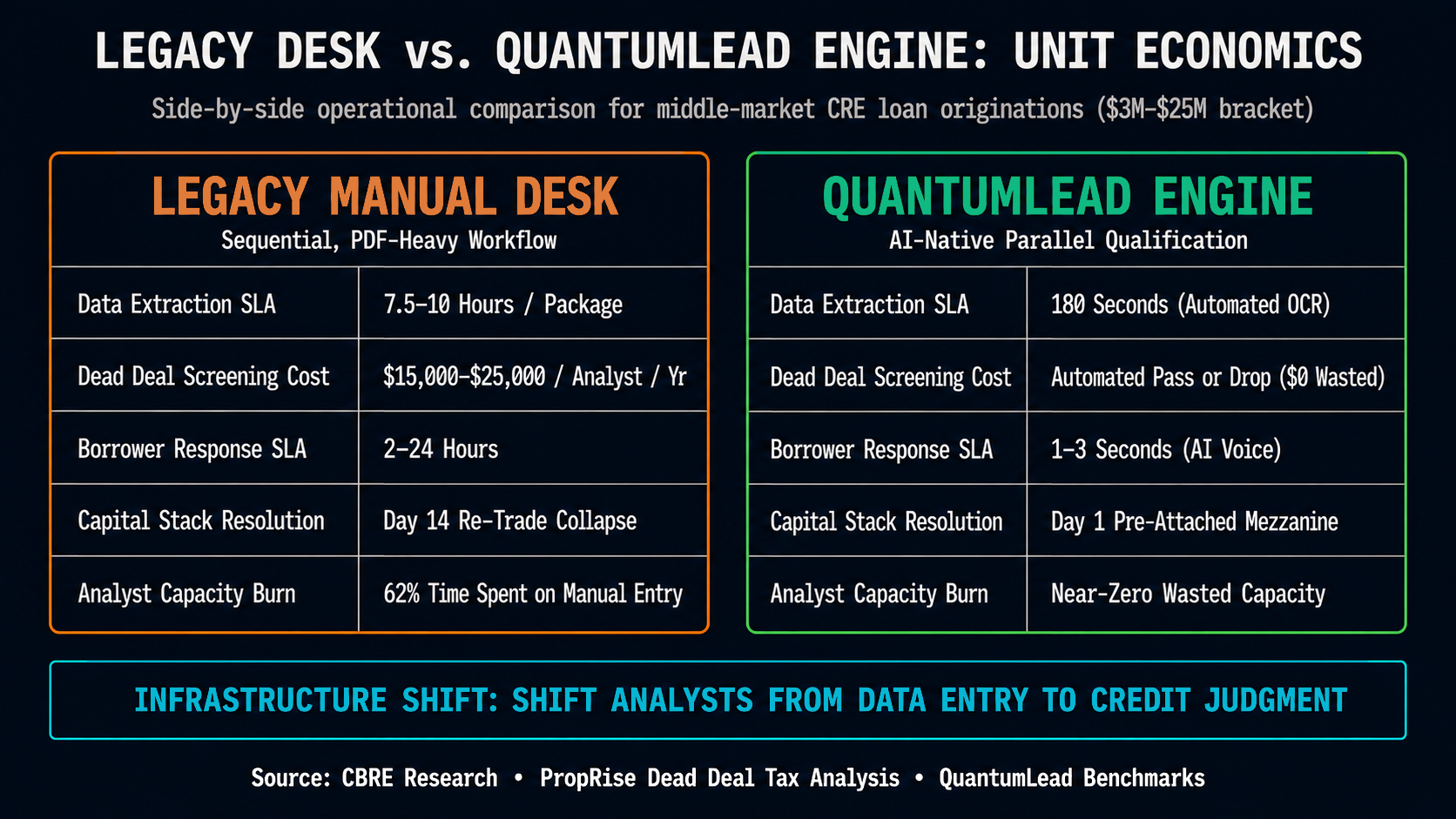
Data Summary: Legacy Manual Desk vs. QuantumLead Engine Unit Economics
- Data Extraction Time: Legacy takes 7.5 to 10 hours per deal package versus 180 seconds with QuantumLead OCR.
- Dead Deal Screening Cost: Legacy costs $15,000 to $25,000 per analyst per year versus automated pass or drop with QuantumLead ($0 wasted capacity).
- Borrower Response Speed: Legacy takes 2 to 24 hours versus 1 to 3 seconds via QuantumLead live Ai voice qualification.
- Capital Stack Resolution: Legacy suffers Day 14 re-trade collapses versus QuantumLead Day 1 pre-attached mezzanine debt gap resolution.
- Analyst Capacity: Legacy burns 62% of analyst hours on data entry versus near-zero wasted capacity with QuantumLead.
What Actually Happens During a QuantumLead Intake Call
Most lenders assume Ai qualification means a chatbot collecting basic information before a human takes over. That is not what we built.
When a borrower enters your QuantumLead pipeline, the qualification happens in real time, while the conversation is live. Within the first 90 seconds our Ai voice engine has verified the property type, confirmed the loan size and timeline, established the borrower’s equity position, and run a preliminary DSCR calculation against current sub-market benchmarks for that specific asset class and geography.
The borrower never knows they are being qualified. The conversation feels like talking to a knowledgeable intake specialist. They answer questions, they get answers back, and by the time the call ends they have already received a preliminary sense of whether your desk is a fit for their deal.
While that conversation is happening, the system is running in parallel. It is pulling available comps for the subject property zip code. It is cross-referencing the borrower’s stated income and expense figures against regional benchmarks. It is flagging any structural red flags: a DSCR that likely will not cover current rates, an LTV request that appears aggressive relative to recent market valuations, a timeline inconsistent with the stated maturity date.
By the time the call ends, your desk has a structured intake summary, not a phone message and a vague sense that the borrower seemed motivated. You have a real decision in under three minutes.
No other platform in the middle-market CRE space is doing live parallel analysis during the intake call. Most are still processing PDFs after the fact. That gap is the competitive advantage QuantumLead gives your desk.
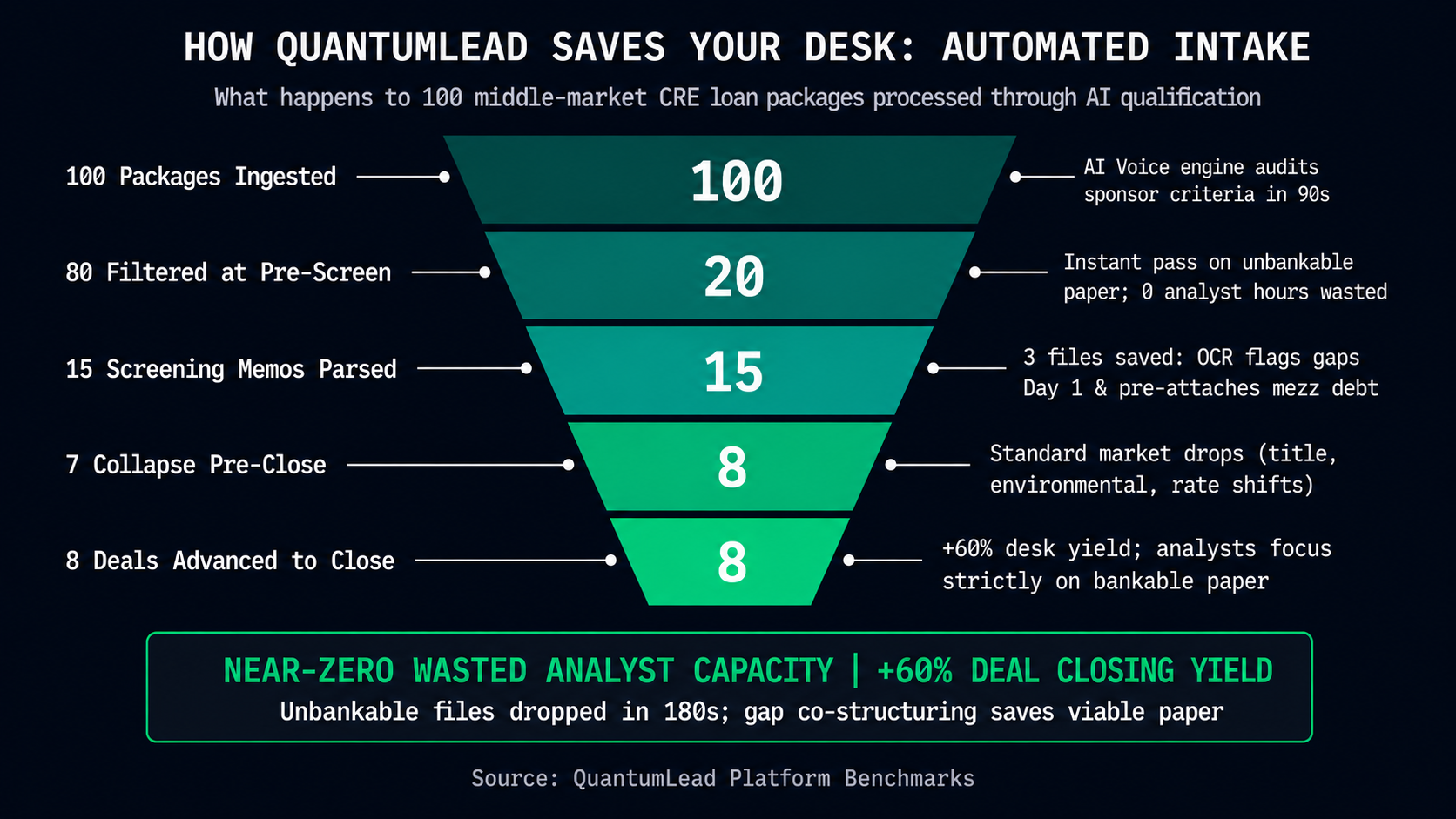
Data Summary: QuantumLead CRE Intake Engine
- 100 packages ingested via 90-second Ai voice qualification.
- 80 unbankable packages screened out automatically in 180 seconds with zero analyst hours wasted.
- 15 screening memos parsed; 3 additional files saved by identifying LTV gaps on Day 1 and co-attaching mezzanine debt up front.
- 7 packages collapse pre-close due to standard market friction (environmental, title, rate shifts).
- 8 packages funded and closed (+60% yield increase over manual baseline).
- Operational Impact: Near-zero wasted analyst capacity; instant 180-second intake SLA.
How We Pre-Structure the Capital Stack Before the Deal Reaches Your Desk
This is the part that eliminates the 11th hour collapse.
When the QuantumLead intake system identifies that a deal’s senior LTV is likely to compress, typically because the property’s current NOI does not adequately support a 75% loan at today’s cap rates, it does not wait for your underwriting team to discover this on Day 4. It flags the gap immediately and triggers our automated mezzanine and preferred equity matching process.
Here is what that looks like in practice. Take a $10 million multifamily property. Current NOI supports a 65% senior loan: $6.5 million. There is a $1.5 million gap if the sponsor expected 75%. Our system identifies that gap in real time and automatically queries our vetted network of mezzanine lenders and preferred equity providers, matching the deal characteristics (asset type, geography, loan size, borrower profile) against active mandates from capital sources already in our network.
By the time the deal file reaches your underwriting team, it arrives with a preliminary capital stack already attached: 65% senior mortgage, 15% mezzanine from a pre-screened provider aligned with the deal profile, 20% sponsor equity. The stack is covered. The deal is not going to collapse 14 days before closing because nobody thought to address the equity gap until it was too late.
This is what pre-attached dual-tranche capital structuring actually means operationally. It is not a feature. It is a process change that eliminates an entire category of deal failure before your team ever touches the file.
“The deal arrives at your underwriting desk with the capital stack already structured. Your team evaluates the deal. They do not rescue it.”
What Single-Lender MSA Exclusivity Actually Means For Your Desk
The exclusivity model deserves a more direct explanation than most platforms give it.
An MSA (Metropolitan Statistical Area - the federally defined geographic boundary of a major city and its surrounding economic region; 384 exist across the United States), or Metropolitan Statistical Area, is defined by the U.S. Office of Management and Budget as a core urban area with a population of at least 50,000, plus its surrounding counties that have strong economic and social ties to the core. There are 384 MSAs across the United States. They range from the New York-Newark-Jersey City MSA with over 20 million people to smaller markets like the Dubuque Iowa MSA with under 100,000.
When we say we license one desk per MSA, we mean that your platform is the only private credit shop in our network that receives deal flow from borrowers in that geographic definition. We do not sell the same Dallas Fort Worth lead to three lenders and let them race to the phone. We do not pool borrower data across clients. We do not re-sell aged leads to secondary buyers.
Every inquiry that originates within your locked MSA comes exclusively to your desk. The borrower has one lender in our network for their market. You.
This model is only viable because of how we build our deal flow: through Ai-driven outbound qualification, not aggregated form fills or broker referrals. We control the origination channel, which means we control the exclusivity. A traditional lead aggregator cannot offer this because they are buying and reselling the same pool of data. We are generating qualified intake directly.
For a debt desk targeting middle-market refinancing in specific geographies, this is the difference between being one of seven lenders on a borrower’s list and being the only institutional option they have spoken to.
The QuantumLead Infrastructure: Four Systems Working Together
01 / Speed
1-3 Second Ai Voice Qualification SLA
The moment a borrower enters your pipeline, our Ai voice engine qualifies the sponsor in real time (property type, DSCR metrics, loan timeline, equity position) before your team touches the file. You receive a structured pre-qualified summary, not a PDF and a phone number.
02 / Efficiency
180-Second OCR Credit Memo
Our system ingests T-12s and Rent Rolls instantly, audits property-level expenses against sub-market benchmarks, and outputs a standardized ready-to-review Credit Memo in 3 minutes. Your analyst starts with a judgment call, not a data entry task.
03 / Structure
Pre-Attached Dual-Tranche Capital Structuring
When cap rate compression cuts your senior LTV to 65%, our system automatically identifies the equity gap and pre-attaches a vetted mezzanine or preferred equity partner from our network, delivering a fully covered capital stack on Day 1. No 11th-hour collapses.
04 / Exclusivity
100% Single-Lender MSA Pipeline Lock
Every deal captured within your target MSA is locked exclusively to your desk. We license one platform per MSA. You never compete against rival debt desks for the same borrower. Your pipeline is yours entirely.
Your Market Window Is Closing
The refinancing wave is here. The borrowers are looking. The only question is whether your desk has the infrastructure to capture them before your competitors lock their territory first.
PwC’s latest Global Private Credit Survey confirms that private credit platforms are entering the most competitive credit environment in the asset class’s history. The firms that build origination infrastructure now will own deal flow for the next cycle. The firms that do not will spend that cycle fighting over aged broker referrals and multi-sold leads.
We license platform capacity on a strict one-lender-per-MSA basis. Once your market is claimed, it is locked. We do not double-sell. We do not cross-pollinate data between clients. Your pipeline is yours entirely.
If your target MSA is still available, this is the conversation that locks it. If your target market is still available, book a call here before a competing desk locks your territory.